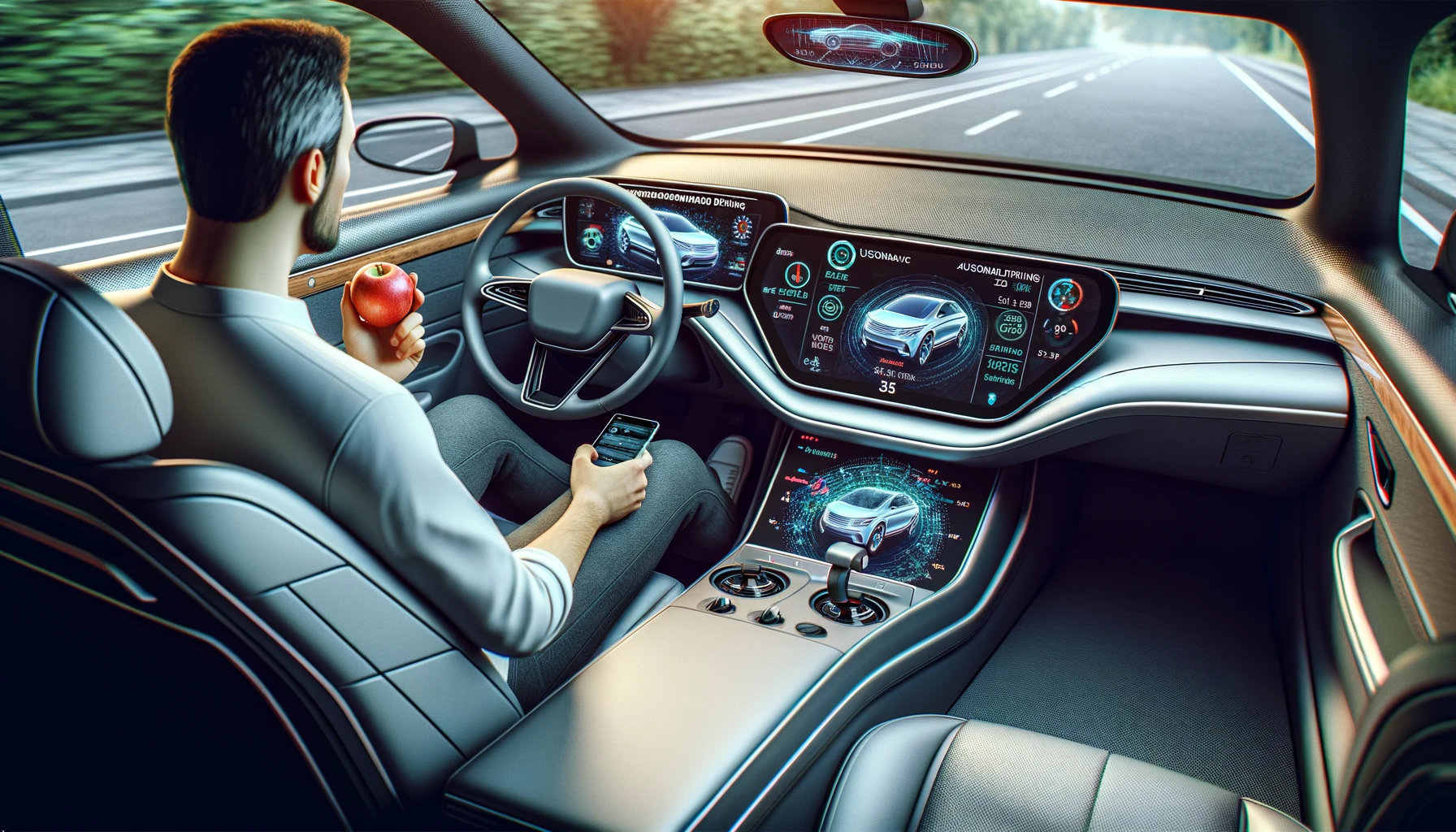
Imagine waking up to the gentle sunlight streaming through windows that adjust themselves based on your preferred wake-up routine, all thanks to AI. Your personalized news briefing is ready, curated to match your interests. As you head out, your smart car predicts traffic and suggests the best route, while also adjusting the cabin temperature to your liking.
This isn’t science fiction; it’s a glimpse into the near future where AI seamlessly integrates into our daily lives, enhancing convenience, efficiency, and well-being. Let’s explore a typical day in this AI-powered world:
Morning:
Morning With Ai
Personalized Health Monitoring: Imagine waking up to a smart mirror that not only reflects your image but also analyzes your sleep patterns and vital signs. This mirror provides you with detailed health insights, such as your heart rate, respiratory rate, and even your stress levels. Based on this data, the mirror can suggest adjustments to your routine, such as recommending a relaxation technique if your stress levels are high or suggesting a light breakfast if your heart rate indicates you may be dehydrated. This personalized health monitoring system helps you start your day on the right foot, ensuring you are aware of your body’s needs and can make informed decisions about your health.
AI-Powered Fitness Assistant: As you prepare for your day, your AI-powered fitness assistant is ready to help you achieve your fitness goals. This assistant has been tracking your progress and knows your fitness level, preferences, and goals. It suggests a workout routine tailored specifically to you, taking into account factors like your current energy levels and any muscle groups that may need extra attention. As you exercise, the AI coach provides real-time feedback, correcting your form and offering encouragement to keep you motivated. This personalized approach to fitness ensures that you get the most out of your workouts and stay on track to reach your goals.
Smart Kitchen: Heading into the kitchen, you’re greeted by a smart fridge that has been busy overnight. Based on your dietary needs, preferences, and the ingredients you have on hand, the fridge suggests recipes for your meals throughout the day. It even takes into account the nutritional content of each meal, ensuring that you are getting the right balance of nutrients. As you select a recipe, the fridge communicates with your smart oven to preheat it to the correct temperature. Throughout the cooking process, the oven guides you step-by-step, ensuring that your meal turns out perfectly every time. This seamless integration of technology in your kitchen not only saves you time and effort but also helps you make healthier choices and enjoy delicious meals tailored to your tastes.
Throughout the Day:
Future Of Ai Office
Effortless Communication: As your day progresses, your AI assistant continues to be your reliable companion, effortlessly managing your schedule and appointments. It keeps track of your meetings, deadlines, and commitments, ensuring that you stay organized and on track. Additionally, it can seamlessly translate languages in real-time, breaking down communication barriers and enabling you to interact with people from diverse backgrounds effortlessly. Whether you’re scheduling a meeting with a colleague from another country or communicating with a client in a different language, your AI assistant makes communication smooth and efficient.
Enhanced Productivity: AI tools play a crucial role in enhancing your productivity throughout the day. By analyzing your work patterns and habits, these tools can identify areas where you can improve efficiency and suggest time management strategies. For example, if you tend to spend too much time on certain tasks, AI can suggest ways to streamline your workflow or automate repetitive tasks, freeing up more time for high-priority work. This proactive approach to productivity ensures that you make the most of your time and achieve your goals more efficiently.
Personalized Learning: In your quest for personal and professional growth, AI serves as a valuable learning companion. AI tutors are designed to adapt to your learning style, offering personalized feedback and suggestions to help you master new skills. Whether you’re learning a new language, honing your professional skills, or exploring a new hobby, AI tutors provide tailored learning experiences that cater to your individual needs. By suggesting relevant resources and adapting to your progress, AI tutors help you achieve your learning goals more effectively and efficiently.
Evening and Beyond:
Smart Entertainment: After a productive day, your AI-powered entertainment system is ready to help you unwind. By analyzing your mood and past preferences, the system recommends movies, TV shows, or music that align with your current emotional state. Whether you’re in the mood for a feel-good comedy, a thrilling action movie, or relaxing music, your entertainment system ensures that you have a personalized and enjoyable experience. This tailored approach to entertainment enhances your relaxation and helps you disconnect from the stresses of the day.
Stress Management: As the day comes to a close, your AI assistant shifts its focus to your well-being. By monitoring your stress levels throughout the day, it can detect when you may be feeling overwhelmed or tense. In such moments, the AI suggests relaxation techniques or mindfulness exercises to help you unwind and de-stress. Whether it’s a guided meditation, deep breathing exercises, or calming music, these suggestions are tailored to your needs and can help you relax and recharge for the next day.
Community Connection: Despite physical distances, AI platforms help you stay connected with your loved ones. Whether it’s through video calls, virtual gatherings, or shared experiences in virtual environments, AI facilitates meaningful interactions with friends and family. These platforms use AI to enhance communication, making it more immersive and engaging. By bridging the gap between physical distances, AI helps you maintain strong connections with your loved ones, fostering a sense of belonging and community.
The Road Ahead: Responsibility and Ethical Considerations:
As we look towards the future of AI, it is essential to consider the responsible development and implementation of this technology. One of the key concerns is bias, as AI systems can inherit biases present in the data used to train them. It is crucial to address these biases to ensure that AI systems are fair and equitable in their decision-making processes. Additionally, privacy is a significant concern, as AI systems often rely on large amounts of personal data. It is essential to implement robust privacy measures to protect individuals’ data and ensure that it is used ethically and responsibly.
Another consideration is job displacement, as AI has the potential to automate many tasks currently performed by humans. While this can lead to increased efficiency and productivity, it also raises concerns about the impact on the workforce. It is important to consider ways to mitigate the impact of AI on jobs, such as retraining programs and policies that support workers in transitioning to new roles.
Embrace the Future Responsibly:
Despite these challenges, the future where AI seamlessly integrates into our lives is within reach. By embracing this technology responsibly, we can unlock its potential to create a better world for all. This involves not only developing AI systems that are fair, transparent, and respectful of privacy but also ensuring that they are used in ways that benefit society as a whole. By working together to address these challenges, we can harness the power of AI to improve our lives and create a more equitable and sustainable future.
Insights
1. Responsible development and implementation of AI are crucial to address concerns about bias, privacy, and job displacement and ensure that AI serves humanity and fosters a more equitable future.
2. Embracing AI technology responsibly can unlock its potential to create a better world for all, but it requires careful consideration of ethical implications and proactive measures to mitigate potential risks.
3. The future where AI seamlessly integrates into our lives is near, and by working together to address challenges and harness the power of AI, we can improve our lives and create a more equitable and sustainable future.
Your Next Action
Advocate for and participate in initiatives that promote responsible AI development and implementation. This includes supporting policies and practices that address bias, privacy concerns, and job displacement, as well as actively engaging in discussions and collaborations aimed at ensuring that AI serves humanity and fosters a more equitable future.
Autonomous systems represent a highpoint of technological advancement, blending artificial intelligence, robotics, and sophisticated sensor technologies to create machines capable of making decisions and operating independently of human intervention. At their core, these systems are designed to perceive their environment, analyze the incoming data, make decisions based on this analysis, and carry out actions to achieve specific goals without direct human control. This capability to operate autonomously has paved the way for innovations that were once the mere domain of science fiction, transforming them into tangible realities that promise to reshape the future of various industries.
Definition and Overview of Autonomous Systems
An autonomous system can be defined as a technology configured to gather data from its surroundings using integrated sensors, interpret this data through advanced algorithms, and execute actions based on its computations. These actions are performed in a real-world environment with a high degree of autonomy, meaning the system can adapt to changes in its environment without external input. The spectrum of autonomous systems ranges from self-driving vehicles and autonomous drones to robotic manufacturing units and smart infrastructure management.
The defining feature of autonomous systems is their reliance on a combination of sensors for data acquisition, data processing units for decision making, and actuators to perform physical actions. This integration enables them to perform complex tasks, from navigating unpredictable urban environments to optimizing manufacturing processes, all while enhancing efficiency, safety, and productivity.
Historical Evolution and Milestones in the Development of Autonomous Systems
The journey towards autonomous systems began in the mid-20th century with the advent of basic computer-controlled machines and has since evolved through various phases of technological advancements. One of the earliest instances of autonomous technology can be traced back to the 1940s with the development of automated anti-aircraft systems and the 1950s with the creation of the first computer-controlled autonomous vehicle in the 1980s.
The real momentum, however, picked up with the digital revolution and the exponential growth in computing power. The 1990s and early 2000s saw the emergence of robotic vacuum cleaners and industrial robots, setting the stage for more sophisticated applications. The DARPA Grand Challenges in the mid-2000s, aimed at fostering the development of autonomous vehicles, marked a significant turning point, showcasing the potential for vehicles to navigate complex terrains without human guidance.
The last decade has witnessed remarkable milestones, with autonomous systems becoming increasingly prevalent. The introduction of commercial drones, autonomous delivery robots, and the testing and deployment of self-driving cars on public roads exemplify the rapid progress in this field. Moreover, the integration of AI and machine learning has significantly enhanced the capabilities of these systems, enabling more complex decision-making processes and adaptive learning capabilities.
Today, autonomous systems are not just a testament to human ingenuity and technological progress; they are reshaping industries, promising to make our cities smarter, our work more efficient, and our lives safer. As these systems continue to evolve, they hold the potential to unlock unprecedented opportunities, heralding a new era of innovation and discovery.
Fundamental Technologies in Autonomous Systems
The functionality and efficiency of autonomous systems hinge on a suite of fundamental technologies that enable these systems to perceive, interpret, and interact with their environment. These technologies, ranging from various types of sensors and data acquisition methods to sophisticated data processing algorithms and communication networks, form the backbone of autonomous operations. Understanding these technologies offers insight into how autonomous systems operate with such a high degree of autonomy and intelligence.
Sensors and Data Acquisition
At the core of any autonomous system is its ability to understand its surroundings, a function made possible through sensors and data acquisition systems. These sensors collect data from the environment, which is then processed to make decisions and execute actions. The primary types of sensors used in autonomous systems include:
– LiDAR (Light Detection and Ranging): LiDAR sensors use laser beams to measure distances and generate precise three-dimensional information about the shape and surface characteristics of surrounding objects. This technology is crucial for autonomous vehicles, providing detailed environmental mapping and obstacle detection.
– Radar (Radio Detection and Ranging): Radar sensors emit radio waves that bounce off objects, measuring the return time to calculate distances, speeds, and angles. This sensor is invaluable for detecting objects under various weather conditions, offering robustness that complements LiDAR data.
– Cameras: Optical cameras capture visual information, enabling autonomous systems to recognize objects, read signs, and understand complex scenarios. When combined with advanced image processing algorithms, cameras are pivotal in identifying and classifying objects in real-time.
These sensors collectively provide a comprehensive dataset about the environment, which autonomous systems use to navigate and make decisions. The fusion of data from multiple sensor types enhances the system’s perception capabilities, allowing for more accurate and reliable decision-making.
Data Processing and AI
The heart of an autonomous system’s intelligence lies in its data processing and artificial intelligence (AI) frameworks. These systems process the vast amounts of data collected by sensors to understand the environment and make informed decisions. Two key technologies in this domain are:
– Machine Learning: Machine learning algorithms analyze and learn from data, enabling autonomous systems to improve their decision-making over time. These algorithms are used for tasks such as pattern recognition, obstacle identification, and predictive modeling.
– Deep Learning: A subset of machine learning, deep learning uses neural networks with many layers (hence “deep”) to process complex data inputs. This technology is particularly effective for processing visual data from cameras, allowing systems to recognize objects, interpret scenes, and make nuanced decisions based on visual cues.
These AI technologies enable autonomous systems to process sensor data in real-time, adapt to new situations, and learn from past experiences, continually improving their performance and reliability.
Actuation Systems
Actuation systems are the mechanisms through which autonomous systems translate digital decisions into physical actions. These include motors, hydraulics, and other mechanical components that control movement, steering, acceleration, and other physical operations. In an autonomous vehicle, for example, the actuation system would execute the commands to turn the wheel, apply the brakes, or accelerate, based on the decisions made by the AI and data processing systems.
Connectivity and Communication
Connectivity and communication technologies play a crucial role in the functionality of autonomous systems, especially in scenarios involving multiple units or integration into broader networks. Two key communication paradigms are:
– IoT (Internet of Things): IoT technology enables autonomous systems to connect to the internet and communicate with other devices or central servers. This connectivity allows for remote monitoring, control, and data exchange, enhancing the system’s capabilities and applications.
– V2X (Vehicle to Everything) Communication: V2X communication encompasses various communication systems that enable vehicles to communicate with each other (V2V), with infrastructure (V2I), with pedestrians (V2P), and with the network (V2N). This technology is crucial for coordinating actions among autonomous vehicles, improving traffic flow, and enhancing safety.
Together, these fundamental technologies equip autonomous systems with the capabilities required to operate independently and intelligently, marking a significant step forward in our technological evolution. As these technologies continue to advance, we can expect autonomous systems to become increasingly sophisticated, opening up new possibilities and applications across a range of industries.
How Autonomous Systems Work
Autonomous systems function through a complex interplay of technologies that allow them to perceive their environment, make informed decisions, navigate and control their actions accordingly, and learn from their experiences. This section delves into the intricacies of how these systems interpret sensor data, decide on the best course of action, navigate their surroundings, and continuously improve their performance over time.
Perception: Interpreting the Environment Using Sensor Data
The perception phase is where autonomous systems gather and interpret data from their surroundings to create a comprehensive understanding of their environment. This process involves the integration of data from various sensors like LiDAR, radar, and cameras, each providing different but complementary information about the environment.
– LiDAR offers precise distance measurements and 3D mapping capabilities, enabling the system to understand the shape and size of nearby objects and terrain.
– Radar provides reliable distance and speed data, particularly useful for detecting moving objects even in poor visibility conditions.
– Cameras add visual context, allowing the system to identify specific objects, read signs, and understand complex scenarios like traffic conditions.
Advanced algorithms then fuse this sensor data to create a unified and accurate representation of the environment. This representation is continuously updated in real-time, allowing the autonomous system to detect changes and respond accordingly.
Decision-making: AI and Algorithms for Decision Making Based on Data
Once an autonomous system has a clear perception of its environment, the next step is to make decisions based on this information. This process involves using AI and machine learning algorithms to evaluate the current situation, predict potential future states, and decide on the best course of action. Decision-making in autonomous systems can include determining the safest path, avoiding obstacles, and responding to dynamic changes in the environment.
AI models are trained on vast datasets to recognize patterns and scenarios, enabling them to make informed decisions quickly. Decision trees, reinforcement learning, and neural networks are among the AI techniques employed to evaluate different options and select the most appropriate action based on the system’s goals and constraints.
Navigation and Control: Path Planning, Obstacle Avoidance, and Control Mechanisms
Navigation and control are where the autonomous system translates its decisions into physical actions. This involves path planning, where the system calculates the optimal route to its destination, and obstacle avoidance, where it modifies its path in response to unexpected obstacles.
– Path Planning: The system uses algorithms to determine the most efficient path to its destination, considering factors like distance, safety, and environmental conditions. Techniques like A (A-star) and Dijkstra’s algorithm are commonly used for this purpose.
– Obstacle Avoidance: Real-time sensor data allows the system to detect and navigate around obstacles, using algorithms to dynamically adjust its path while maintaining its overall route objectives.
– Control Mechanisms: The decisions and planned paths are executed through control systems that manage the autonomous system’s speed, direction, and other navigational aspects. PID (Proportional, Integral, Derivative) controllers and fuzzy logic are examples of control mechanisms that ensure smooth and accurate operation.
Learning and Adaptation: Machine Learning and Feedback Loops for Improving Performance Over Time
A critical feature of autonomous systems is their ability to learn from experience and improve over time. This learning process is facilitated by machine learning algorithms and feedback loops that analyze the system’s performance, identify areas for improvement, and adjust the system’s operations accordingly.
Through continuous operation and exposure to diverse situations, autonomous systems collect new data that is fed back into their AI models. This data helps to refine the models, making them more accurate and adaptable to changing conditions. Reinforcement learning, a type of machine learning where the system learns to make better decisions through rewards and penalties, is particularly effective for this continuous improvement process.
This cycle of learning and adaptation is what enables autonomous systems to become more efficient and reliable, reducing errors and enhancing their ability to handle complex and unpredictable environments.
In conclusion, the operation of autonomous systems encompasses a sophisticated sequence of steps: perceiving the environment through advanced sensor technology, making informed decisions using AI and algorithms, navigating and controlling actions in the physical world, and continuously learning and adapting to improve performance. These capabilities are what make autonomous systems such an integral part of the future of technology, with endless possibilities for innovation and application across various sectors.
Applications of Autonomous Systems
Autonomous systems have surged beyond theoretical concepts and prototypes to become integral components of various sectors, revolutionizing how operations and services are delivered. From enhancing efficiency in transportation and manufacturing to improving precision in healthcare and urban management, these systems offer a glimpse into a future where technology seamlessly integrates into every aspect of life. Here’s an in-depth look at their applications across different domains.
Autonomous Vehicles: Cars, Drones, and Maritime Vessels
– Cars: Autonomous cars, often referred to as self-driving cars, use a combination of sensors, cameras, and AI to navigate roads without human intervention. Companies like Tesla, Waymo, and Cruise are at the forefront, testing and refining these vehicles to ensure safety and reliability. For instance, Waymo operates a fully autonomous ride-hailing service in Phoenix, Arizona, showcasing the practical application of this technology.
– Drones: Unmanned Aerial Vehicles (UAVs), commonly known as drones, are used for a variety of purposes, including aerial photography, surveying, and delivery services. Amazon’s Prime Air and Wing by Alphabet are pioneering drone delivery services, aiming to reduce delivery times and increase efficiency by autonomously navigating to customers’ locations.
– Maritime Vessels: The maritime industry is exploring autonomous technology to operate ships with minimal or no crew onboard. The Yara Birkeland, for example, is the world’s first fully electric and autonomous container ship, designed to reduce emissions and improve safety in maritime transport.
Industrial Automation: Robotics in Manufacturing and Logistics
– Manufacturing: Robotics and autonomous systems in manufacturing increase production efficiency, improve safety, and reduce costs. Automotive manufacturers like Tesla use robots for assembling vehicles, demonstrating how these technologies can work alongside humans to enhance productivity.
– Logistics: Autonomous robots are revolutionizing logistics and supply chain management. Companies like Amazon utilize autonomous robots in their warehouses to move goods efficiently, reducing processing time and human error.
Smart Cities: Traffic Management, Public Safety, and Infrastructure Maintenance
– Traffic Management: Autonomous systems in smart cities optimize traffic flow and reduce congestion. Singapore’s Smart Nation initiative, for instance, employs AI-driven traffic management systems to analyze traffic data in real-time, adjusting traffic signals to improve flow and reduce bottlenecks.
– Public Safety: Drones are used for surveillance and emergency response, offering a bird’s-eye view during natural disasters or search and rescue operations. For example, drones equipped with thermal imaging cameras have been used in fire departments to locate hotspots in wildfires.
– Infrastructure Maintenance: Autonomous robots are deployed for inspecting and maintaining critical infrastructure. In Japan, autonomous inspection robots are used to monitor aging infrastructure, like tunnels and bridges, ensuring timely maintenance and safety.
Healthcare: Robotic Surgery and Patient Care Robots
– Robotic Surgery: Surgical robots, such as the da Vinci Surgical System, allow surgeons to perform complex procedures with greater precision, flexibility, and control than traditional techniques. These systems translate the surgeon’s hand movements into smaller, more precise movements of tiny instruments inside the patient’s body.
– Patient Care Robots: In the realm of patient care, robots assist with tasks ranging from medication delivery to companionship, improving the quality of care and efficiency in healthcare settings. Moxi, a hospital robot assistant, helps nurses by autonomously performing routine tasks like delivering supplies, allowing medical staff to focus more on patient care.
These examples illustrate the profound impact autonomous systems are having across multiple industries, heralding a future where such technologies become ubiquitous, enhancing efficiency, safety, and quality of life. As these systems continue to evolve and integrate into society, they promise to unlock even more innovative applications and solutions to complex challenges.
Case Studies and Real-World Examples
Autonomous systems have been deployed across various sectors, leading to both remarkable successes and instructive challenges. By examining specific case studies, we can gain insights into the practical applications of these technologies, the benefits they offer, and the hurdles encountered during their implementation. This section provides a detailed analysis of a successful autonomous system deployment and reflects on lessons learned from notable challenges or failures.
Successful Deployment: Waymo’s Autonomous Ride-Hailing Service
Background: Waymo, a subsidiary of Alphabet Inc., has emerged as a leader in autonomous vehicle technology. Its most significant achievement is the launch of Waymo One, an autonomous ride-hailing service in Phoenix, Arizona, which represents one of the first commercial applications of fully autonomous vehicles in the world.
Implementation: The deployment involved extensive testing and refinement of Waymo’s autonomous driving technology, which includes a sophisticated combination of sensors, cameras, and AI algorithms to navigate roads safely without human intervention. Before launching the service, Waymo conducted millions of miles of testing on public roads and in simulated environments to ensure the safety and reliability of its vehicles.
Outcome: Waymo One has successfully provided thousands of rides to members of the public without safety drivers, showcasing the potential of autonomous vehicles to transform urban mobility. The service has demonstrated impressive safety records and high customer satisfaction, highlighting the viability of autonomous ride-hailing as a sustainable and convenient transportation solution.
Lessons Learned: The success of Waymo One underscores the importance of rigorous testing and incremental deployment in achieving reliable autonomous systems. Waymo’s approach to gradually expanding its service area and continuously refining its technology based on real-world data has been key to its success. This case study illustrates the potential of autonomous vehicles to enhance urban transportation but also emphasizes the need for robust safety protocols and regulatory compliance.
Challenges and Failures: Uber’s Autonomous Vehicle Incident
Background: In contrast to Waymo’s success, Uber’s foray into autonomous vehicles faced a significant setback when one of its self-driving cars was involved in a fatal accident in Tempe, Arizona, in March 2018. This incident marked the first pedestrian death associated with autonomous vehicle technology and led to widespread scrutiny of the safety of such systems.
Implementation: Uber had been testing its autonomous vehicles in multiple cities, aiming to develop its own ride-hailing service powered by self-driving technology. The vehicles were equipped with advanced sensors and AI algorithms similar to those used by other companies in the field.
Outcome: The incident resulted in Uber temporarily halting its autonomous vehicle testing and sparked an investigation by the National Transportation Safety Board (NTSB). The investigation revealed several safety issues, including problems with the vehicle’s software and its ability to correctly identify and respond to pedestrians in certain situations.
Lessons Learned: The Uber incident highlights the critical importance of safety and ethical considerations in the development and deployment of autonomous systems. It underscored the need for comprehensive testing in varied environments, the implementation of fail-safes, and the establishment of clear regulatory frameworks to govern the safe use of autonomous technology. This case also emphasized the importance of transparency and accountability in addressing the challenges and failures associated with these systems.
These case studies demonstrate the complex landscape in which autonomous systems operate, marked by groundbreaking advancements and significant challenges. Successes like Waymo One showcase the transformative potential of autonomous technologies, while incidents like Uber’s serve as stark reminders of the need for caution, rigorous testing, and ethical considerations in their development and deployment. Together, they offer valuable lessons for future endeavors in the realm of autonomous systems.
Challenges and Future Directions
The advancement and integration of autonomous systems into daily life and various industries come with a set of technical, safety, and scalability challenges that need to be addressed to ensure their successful adoption and long-term viability. Understanding these challenges is crucial for developing strategies that will guide the future direction of autonomous technology development and deployment.
Technical Challenges
– Sensor Fusion: One of the primary technical hurdles in autonomous systems is the effective integration of data from multiple sensors (e.g., LiDAR, radar, cameras) to create a cohesive and accurate understanding of the environment. Sensor fusion involves complex algorithms that must accurately combine data with varying degrees of precision, reliability, and field of view, making it a significant challenge for engineers.
– Decision-making in Unpredictable Environments: Autonomous systems must make rapid decisions in environments that are inherently unpredictable, such as busy urban settings or during unexpected weather conditions. Developing AI and machine learning algorithms that can accurately predict and react to infinite possible scenarios is a daunting task that requires continuous advancement in AI research and computational capabilities.
Safety and Security
– Cybersecurity Threats: As autonomous systems rely heavily on data communication and connectivity, they become vulnerable to cybersecurity threats. Hackers could potentially take control of autonomous vehicles, industrial robots, or other systems, posing significant risks. Ensuring robust cybersecurity measures that can evolve with emerging threats is paramount.
– Safety Protocols: Establishing comprehensive safety protocols is critical for mitigating the risks associated with autonomous system failures or malfunctions. This includes developing fail-safe mechanisms, redundancy systems, and emergency response strategies to protect both the systems and the humans who interact with them.
Scalability and Infrastructure
– Integration into Existing Systems: As autonomous technologies advance, integrating them into existing systems and societal frameworks poses significant challenges. This includes legal, regulatory, and logistical hurdles that must be overcome to ensure seamless operation alongside human-operated systems.
– Urban Infrastructure Adaptations: The widespread adoption of autonomous vehicles and other systems necessitates significant adaptations to urban infrastructure. This includes modifying roads, traffic management systems, and public spaces to accommodate and optimize the performance of autonomous systems. Such adaptations require substantial investment and collaborative efforts between technology developers, city planners, and government agencies.
Future Directions
Addressing these challenges opens up an array of future directions for the development and deployment of autonomous systems:
– Advancements in AI and Machine Learning: Continuous research and development in AI will enhance the decision-making capabilities of autonomous systems, enabling them to handle more complex scenarios with greater accuracy and reliability.
– Enhanced Sensor Technology: Innovations in sensor technology will improve the precision, range, and durability of the sensors used in autonomous systems, enabling better performance in diverse environmental conditions.
– Robust Cybersecurity Frameworks: Developing advanced cybersecurity frameworks and protocols will ensure the security and integrity of autonomous systems, protecting them from malicious attacks.
– Collaborative Regulatory Efforts: Establishing clear regulatory frameworks and standards in collaboration with government agencies, industry leaders, and the public will facilitate the safe and ethical deployment of autonomous technologies.
– Smart Infrastructure Development: Investments in smart infrastructure will provide the necessary foundation for autonomous systems to operate efficiently and safely within urban environments, paving the way for their widespread adoption.
By addressing these challenges and exploring these future directions, the potential of autonomous systems to revolutionize various aspects of society and industry can be fully realized, leading to safer, more efficient, and more sustainable solutions for the future.
Conclusion
Autonomous systems, powered by advanced sensors, AI, and machine learning, demonstrate an impressive capacity for improving efficiency, safety, and productivity. From self-driving cars and drones to robotic surgery and smart city infrastructures, these technologies are paving the way for innovative solutions to longstanding challenges. Successful deployments, like Waymo’s autonomous ride-hailing service, showcase the practical benefits of these systems, while also emphasizing the importance of rigorous testing, safety protocols, and ethical considerations.
However, the journey of autonomous systems is not without its hurdles. Technical challenges such as sensor fusion and decision-making in unpredictable environments, alongside critical concerns over safety, security, and scalability, highlight the need for continuous innovation and regulation. The incidents and setbacks experienced by companies like Uber underscore the importance of addressing these challenges head-on, with a commitment to safety and ethical responsibility.
In Summary, autonomous systems represent a dynamic and evolving field with the power to revolutionize our daily lives and industries. By harnessing the lessons learned from past deployments and focusing on innovation, safety, and ethical practices, we stand on the brink of unlocking their full potential. As these technologies continue to mature, their integration into society promises not only to enhance current operations but also to open doors to unforeseen opportunities, marking a new era of technological advancement and human achievement.
Insights
Autonomous systems are revolutionizing industries by enhancing efficiency, safety, and innovation through advancements in AI and robotics.
Technical and ethical challenges remain, including sensor fusion, decision-making in unpredictable environments, cybersecurity, and integration into existing systems.
Continuous innovation and regulation are crucial for the safe and effective deployment of autonomous technologies, with a need for industry and governmental collaboration.
Your Next Action
Explore current academic and industry research on autonomous systems to stay informed about the latest developments and contribute to the discussion on overcoming challenges for safe and ethical deployment.